

Texas 3D Face Recognition Database
(Texas 3DFRD)
NOW AVAILABLE!!
Research on 3D human face recognition at LIVE is being conducted in collaboration with former Advanced Digital Imaging Research, LLC, Friendswood, TX.
Shalini Gupta , Mia K. Markey , Kenneth R. Castleman, and Alan C. Bovik
The Texas 3D Face Recognition database (Texas 3DFRD) of 1149 2D and 3D facial images is now available to qualified researchers at no cost. If you use this database in your research, please reference our following articles and this database:
2 S. Gupta, K. R. Castleman, M. K. Markey, A. C. Bovik, "Texas 3D Face Recognition Database", IEEE Southwest Symposium on Image Analysis and Interpretation, May 2010, p 97-100, Austin, TX.
3 S. Gupta, K. R. Castleman, M. K. Markey, A. C. Bovik, "Texas 3D Face Recognition Database", URL: http://live.ece.utexas.edu/research/texas3dfr/index.htm.
In order to download the database, please click on the link (by clicking on the link you agree to abide by the terms and conditions) DATABASE .
A pre-print of our paper describing this database is present along with the data. If you wish to obtain only the pre-print and do not need access to the dataset, please contact Dr. Shalini Gupta by sending her an email: shalini.gupta@ieee.org .
Description
A detailed description of the various aspects of the Texas 3DFRD database including its contents, the data acquisition process, preprocessing steps, and data partitions (training, gallery, and probe) that were employed previously to develop the Anthropometric 3D Face Recognition algorithm 1 at LIVE are provided in the following published article:
2 Gupta, S.; Castleman, K. R.; Markey, M. K.; Bovik, A. C., "Texas 3D Face Recognition Database," IEEE Southwest Symposium on Image Analysis & Interpretation, p. 97-100, 23-25 May 2010, Austin, TX.
Briefly, the Texas 3D Face Recognition (Texas 3DFR) database is a collection of 1149 pairs of facial color and range images of 105 adult human subjects. These images were acquired using a stereo imaging system manufactured by 3Q Technologies (Atlanta, GA) at a very high spatial resolution of 0.32 mm along the x, y, and z dimensions. During each acquisition, the color and range images were captured simultaneously and thus the two are perfectly registered to each other (Figure 1).
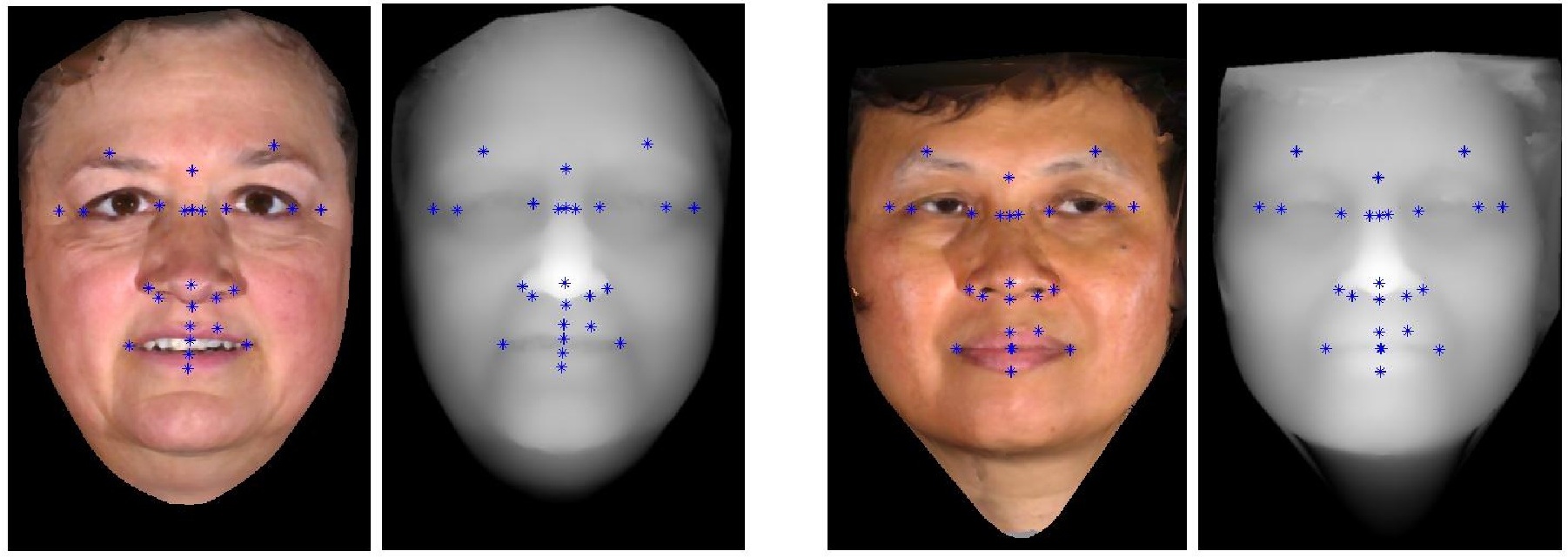
Figure 1: Example images from the Texas 3DFRD
This large database of two 2D and 3D facial models was acquired at the company Advanced Digital Imaging Research (ADIR), LLC (Friendswood, TX), formerly a subsidiary of Iris International, Inc. (Chatsworth, CA), with assistance from research students and faculty from the Laboratory for Image and Video Engineering (LIVE) at The University of Texas at Austin. This project was sponsored by the Advanced Technology Program of the National Institute of Standards and Technology (NIST).
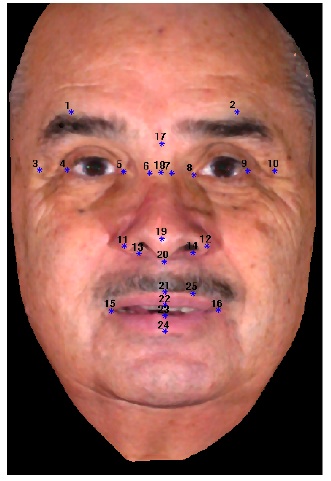
Figure 2: The 25 anthropometric facial fiducial points available for each face in the Texas 3DFRD
The role of the Texas 3D Face Recognition Database is complementary to other existing 3D facial databases. These include the Face Recognition Grand Challenge database ( http://www.frvt.org/FRGC/ ), the Bosphorus database ( http://bosphorus.ee.boun.edu.tr/ ) and the Binghampton 3D Facial Expression database ( http://www.cs.binghamton.edu/~lijun/Research/3DFE/3DFE_Analysis.html ). To aid researchers in focusing primarily on the development of face recognition algorithms, the facial data in Texas 3DFRD has been (a) pre-processed to remove extraneous non-facial data, and has been (b) normalized to a frontal pose and a standardized position (Figure 1 and Figure 2). The 3D facial data has been acquired using a fast stereo imaging system with perfectly registered 3D and 2D images, which unlike range imaging systems, can be practically deployed in airport screening applications.
Numerous other features that of Texas 3DFRD that are complementary to the existing databases are detailed in the published article 2 .
This web page is maintained by Dr. Shalini Gupta. Please email any further questions about the Texas 3D Face Recognition Database directly to her at shalini.gupta@ieee.org .
Copyright Notice
-----------COPYRIGHT NOTICE STARTS WITH THIS LINE------------
Copyright (c) 2010 The University of Texas at Austin
All rights reserved.
Permission is hereby granted, without written agreement and without license or royalty fees, to use, copy, modify, and distribute this database (the images, the results and the source files) and its documentation for any purpose, provided that the copyright notice in its entirety appear in all copies of this database, and the original source of this database, Laboratory for Image and Video Engineering (LIVE, http://live.ece.utexas.edu) and Advanced Digital Imaging Research, LLC, Friendswood, TX, is acknowledged in any publication that reports research using this database.
The following papers are to be cited in the bibliography whenever the database is used as:
*S. Gupta, K. R. Castleman, M. K. Markey, A. C. Bovik, "Texas 3D Face Recognition Database", IEEE Southwest Symposium on Image Analysis and Interpretation, May 2010, p 97-100, Austin, TX.
*S. Gupta, K. R. Castleman, M. K. Markey, A. C. Bovik, "Texas 3D Face Recognition Database", URL: http://live.ece.utexas.edu/research/texas3dfr/index.htm.
IN NO EVENT SHALL THE UNIVERSITY OF TEXAS AT AUSTIN BE LIABLE TO ANY PARTY FOR DIRECT, INDIRECT, SPECIAL, INCIDENTAL, OR CONSEQUENTIAL DAMAGES ARISING OUT OF THE USE OF THIS DATABASE AND ITS DOCUMENTATION, EVEN IF THE UNIVERSITY OF TEXAS AT AUSTIN HAS BEEN ADVISED OF THE POSSIBILITY OF SUCH DAMAGE.
THE UNIVERSITY OF TEXAS AT AUSTIN SPECIFICALLY DISCLAIMS ANY WARRANTIES, INCLUDING, BUT NOT LIMITED TO, THE IMPLIED WARRANTIES OF MERCHANTABILITY AND FITNESS FOR A PARTICULAR PURPOSE. THE DATABASE PROVIDED HEREUNDER IS ON AN "AS IS" BASIS, AND THE UNIVERSITY OF TEXAS AT AUSTIN HAS NO OBLIGATION TO PROVIDE MAINTENANCE, SUPPORT, UPDATES, ENHANCEMENTS, OR MODIFICATIONS.
-----------COPYRIGHT NOTICE ENDS WITH THIS LINE------------